
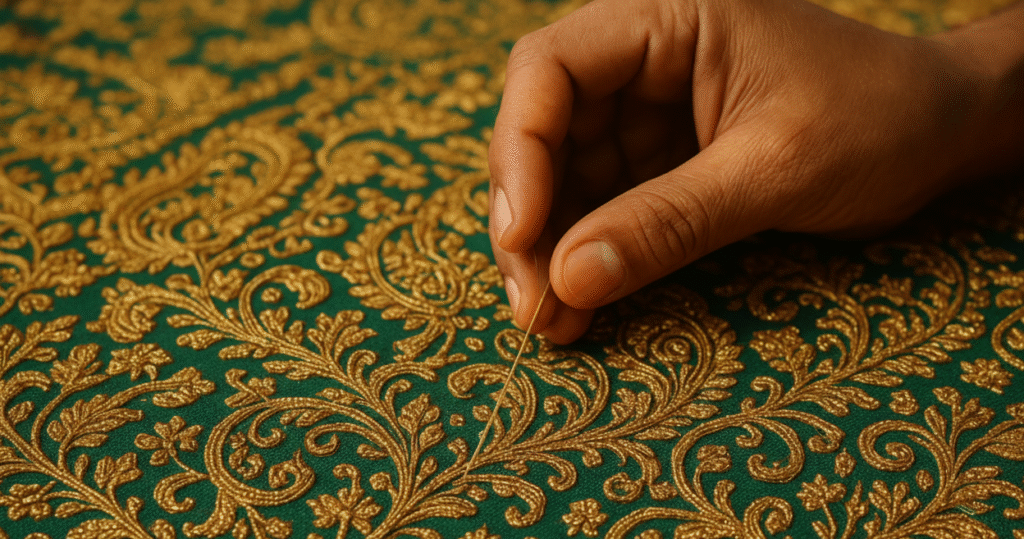
ZARI WORK
Material Used:
- Zari Threads: These are metallic threads made from fine gold, silver, or synthetic metallic filaments. Modern Zari threads often combine a metallic coating over silk or cotton for flexibility and shine. They come in multiple colors, including gold, silver, and multicolored variants, suitable for hand embroidery, jewellery making, tassels, and decorative borders
- Fabric Base: Zari is traditionally applied on silk, cotton, organza, velvet, and brocade fabrics. Banarasi silk, Kanchipuram silk, Chanderi silk, and Kota Doria are popular choices because they provide a durable and rich background for metallic embroidery
- Needles and Hooks: Hand embroidery techniques often use Aari needles, which are specialized hooks that allow continuous chain stitches for intricate motifs. Other tools include tulip or iron needles for Zardosi and Dapka work
- Supplementary Materials: Beads, sequins, mirrors, pearls, and colored threads may be integrated with Zari threads to enhance texture and visual appeal
Craft Making Processes
- Aari Work: Uses a hooked needle to create delicate chain stitches with Zari thread, often forming floral or paisley motifs on sarees, dupattas, or blouse borders. This technique allows detailed embroidery at high speed
- Zardosi Work: Involves coiling and stitching metallic wires, braids, and sequins to create raised patterns. Traditional Zardosi typically uses pure gold or silver threads and may include beads or stones for embellishment
- Gota and Kinari Work: Small decorative metallic ribbons (Gota) or braided trims (Kinari) are stitched onto fabric to form patterns or outline designs, commonly used in wedding attire and ceremonial garments
- Patch and Applique Work: Zari threads can be pre-woven or embroidered into patches, motifs, or tassels, which are later sewn onto garments, accessories, or craft projects like bags and jewelry
Applications
Zari work is applied on bridal sarees, lehengas, dupattas, blouses, decorative cushions, handbags, and jewelry accessories. The metallic shimmer of Zari threads adds prestige and elegance and is a hallmark of Indian traditional textile arts
Overall, Zari craft combines specialized metallic threads, quality fabrics, and skilled handwork techniques to create intricate, luxurious designs that are widely loved both for traditional use and contemporary decorative crafts
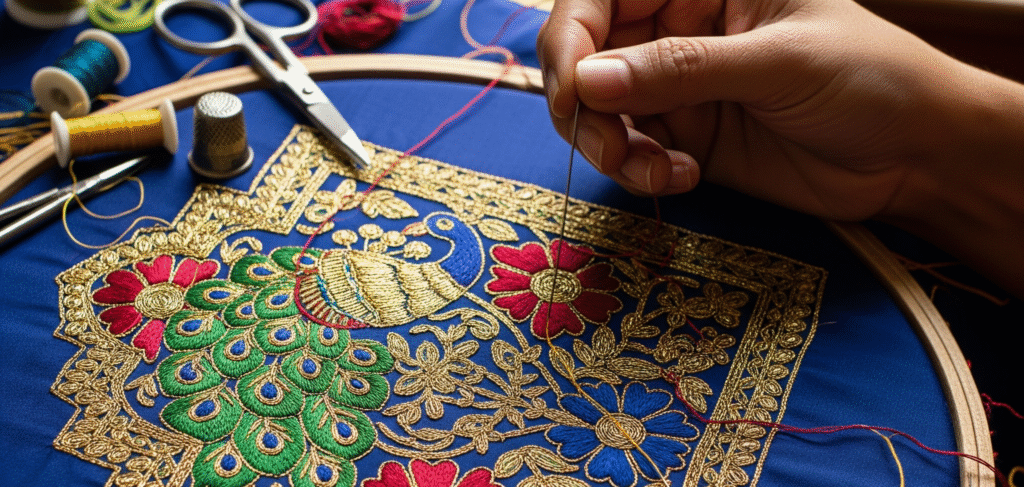
HAND EMBROIDERY
Materials Used:
- Fabric: Natural fabrics like cotton, linen, silk, or velvet are preferred for their durability and ease of stitching. Lightweight fabrics such as muslin or voile are ideal for delicate patterns, while sturdier fabrics like canvas or denim suit larger designs . Always pre-wash and iron fabric to prevent shrinking or distortions.
- Threads: Options include cotton embroidery floss (stranded cotton), pearl cotton, silk threads, metallic threads, and novelty floss (glittered or multi-colored). Floss strands can be separated to control thickness, and pearl cotton is typically used as is for outlining or defining stitches
- Needles: Embroidery needles vary in size and type, such as tapestry, milliner, chenille, quilting, or sashiko needles, each suited for different threads or techniques. Medium-sized needles are versatile for most projects
- Hoops/Frames: Embroidery hoops or frames keep fabric taut, prevent puckering, and help maintain uniform stitch tension
- Embellishments: Beads, sequins, pearls, and metallic threads are often added for texture, dimension, or luxury finishes
- Other essentials: Small scissors for trimming threads, pencils or fabric markers for transferring patterns, and carbon paper for stencil designs
Craft Making Process:
The process of hand embroidery generally follows these steps:
1. Concept and Design
Embroidery begins with a design idea. This can be hand-sketched or digitally prepared based on inspiration from nature, culture, or personal creativity. Once finalized, the design is transferred to the fabric using tracing paper, a water-soluble pen, or carbon paper for accurate outlines
2. Preparing the Fabric
- Stretch the fabric on a hoop or frame to keep it smooth and taut.
- Prewash and iron the fabric to prevent future wrinkles or distortions.
- Ensure the design aligns symmetrically with the fabric, especially for larger or intricate patterns
3. Thread and Needle Preparation
- Select thread type and separate strands if needed.
- Thread the appropriate needle for the stitch and fabric thickness.
- Secure the starting end of the thread with a small knot or anchoring stitch
4. Stitching Techniques
Basic stitches form the foundation of hand embroidery, while advanced stitches and embellishments add depth and texture. Common stitches include:
- Running Stitch: Simple outline stitch, quick and versatile.
- Back Stitch: Strong, continuous lines for outlines.
- Split Stitch: Creates a braided texture.
- Stem Stitch: Ideal for curves and stems.
- Satin Stitch: Fills areas with smooth, even coverage.
- French Knot: Adds small, decorative knots with texture
Advanced techniques may involve Aari work, Chikankari, Zardozi, goldwork, beadwork, or applique for additional intricacy and embellishment
5. Quality Control and Finishing
- Inspect embroidery for uniformity, stitch consistency, and securely attached embellishments.
- Trim excess threads, wash gently to remove marks, and iron carefully to flatten wrinkles.
- Apply optional finishing touches like frames, cushions, or decorative mounting
6. Display or Packaging
Completed pieces are either framed, sewn into apparel, or incorporated into home décor items. Finished embroidery showcases skill, creativity, and the careful selection of materials, preserving the craftsmanship for years
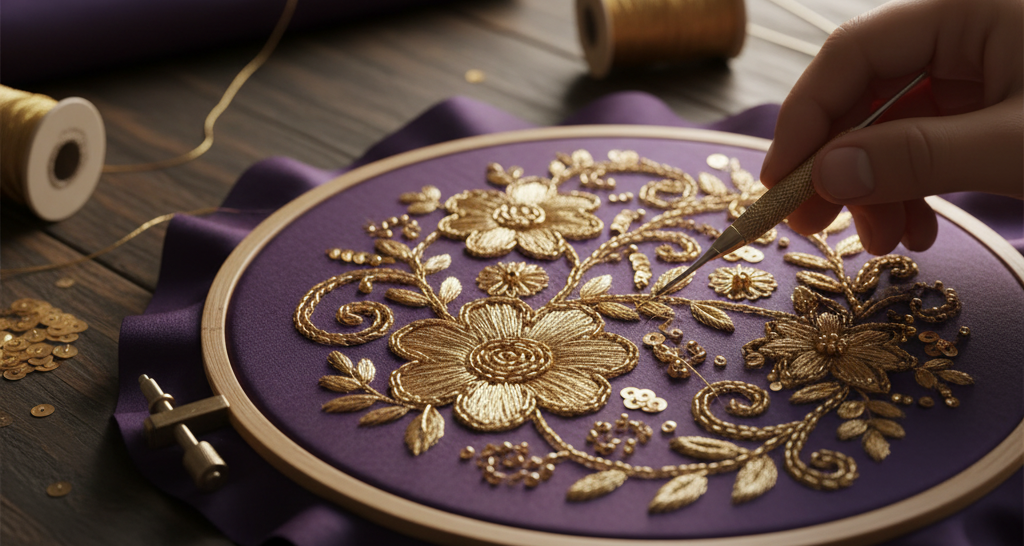
ARI WORK
Materials Used:
- Fabric: Silk, cotton, velvet, Chanderi, organza, georgette, and net are commonly used. The choice depends on the intricacy and final use of the embroidery.
- Threads: Silk, cotton, and metallic zari threads in multiple colors; also golden and silver threads for rich motifs.
- Aari Needle (Hooked Needle): A long, slender needle with a hook at the tip, resembling a crochet needle, used to pull the thread through the fabric to form chain stitches.
- Embellishments: Beads (seed beads or cut beads), sequins, rhinestones, semi-precious stones, pearls, and embroidery wires (bullion, French wire) to enhance the designs.
- Tools: Wooden or metal frames (hoop or “khaka”) for stretching the fabric, thread cutters or embroidery scissors, chalk or fabric markers for design tracing, and thread handling accessories like thimbles.
- Additional Accessories: Small wooden mallet for flattening zari threads after stitching and fabric glue to secure stitches on the reverse side.
Craft Making Process:
- Fabric Preparation: The chosen fabric is stretched tightly over a wooden or metal frame to remove folds and maintain consistent tension during embroidery.
- Design Tracing: Using pencil, chalk, or washable markers, the design is traced onto the fabric. For detailed motifs, tracing paper or “chapaai” with holes is used to transfer the design using a fine powder solution.
- Starting the Stitch: The threaded Aari needle is inserted from the underside of the fabric. The hook catches the thread and is pulled through the upper side, forming a loop. The needle is then re-inserted at a short distance to lock the previous stitch, creating a continuous chain stitch.
- Adding Embellishments: While stitching, beads, sequins, and stones are added by placing them onto the needle and securing them with the chain stitch. This adds depth and shine to the embroidery.
- Completing the Pattern: The chain stitch continues along the traced design until the entire motif is covered. Multiple artisans may work together for large fabrics to reduce time.
- Finishing Techniques: For metallic threads like zari, a wooden mallet flattens the thread on the reverse side to enhance appearance. Loose threads are trimmed, glue may be applied to prevent unraveling, and the fabric is washed and ironed to complete the process.